
A headache that keeps getting worse. A sudden seizure. Trouble remembering things that were never a problem before.
These symptoms can have many causes. But when they appear without a clear reason, especially when they are new or getting worse, they deserve medical attention.
A brain tumour does not always cause obvious symptoms at first. Some grow slowly, while others affect important brain functions within a short time.
During International Brain Tumour Awareness Week, October 24–31, 2026, the message is simple: know the warning signs, seek medical advice when something changes, and understand the treatment options available.
Why Brain Tumour Awareness Matters
The International Brain Tumour Alliance (IBTA) began its awareness-week campaign in 2007. Today, it brings together patients, families, doctors and support organisations to raise awareness, encourage research and improve access to care.
Brain and central nervous system cancers account for a relatively small share of all cancers, but their impact can be severe.
According to the GLOBOCAN 2024 estimates, around 324,000 new brain and CNS cancer cases and 249,000 deaths occurred worldwide in 2024.
Children are affected too. Brain tumours are the most common solid tumours in childhood.
One particularly difficult cancer is glioblastoma, an aggressive brain tumour seen mainly in adults. Studies involving patients receiving standard treatment have reported median survival of around 15–18 months. Individual outcomes vary considerably.
Behind these numbers are families managing appointments, treatment decisions, work, finances and long periods of uncertainty.
Brain Tumour Warning Signs You Should Know
Brain tumour symptoms depend on where the growth is located, how large it is and how quickly it develops.
Some changes are easy to mistake for stress, migraines or tiredness.
Watch for:
- Headaches: New, frequent or worsening headaches, particularly those that feel different from usual.
- Seizures: A seizure in someone who has never experienced one before.
- Nausea or vomiting: Repeated vomiting, sometimes worse in the morning, without an obvious cause.
- Vision or speech problems: Blurred or double vision, difficulty speaking or trouble understanding words.
- Balance and movement problems: Unexplained weakness, difficulty walking or poor coordination.
- Memory or behaviour changes: Increasing confusion, unusual forgetfulness or noticeable personality changes.
Having one of these symptoms does not mean someone has a brain tumour. Many other conditions can cause similar problems.
Still, new or persistent symptoms need medical evaluation. A first seizure, sudden weakness, severe new neurological symptoms or loss of consciousness requires emergency care.
Are All Brain Tumours Cancerous?
No. Brain tumours can be benign (non-cancerous) or malignant (cancerous).
A benign tumour may grow slowly, but its location can still make it dangerous. Even a non-cancerous growth can affect vision, movement or other functions when it presses against nearby brain tissue.
Doctors also distinguish between primary and metastatic tumours.
Primary brain tumours start in the brain or nearby tissues. Examples include gliomas, meningiomas and pituitary tumours.
Metastatic brain tumours develop when cancer from another part of the body, such as the lung, breast or kidney, spreads to the brain.
The distinction matters because treatment for a slow-growing meningioma may be very different from treatment for glioblastoma or cancer that has spread to the brain.
How Doctors Diagnose a Brain Tumour
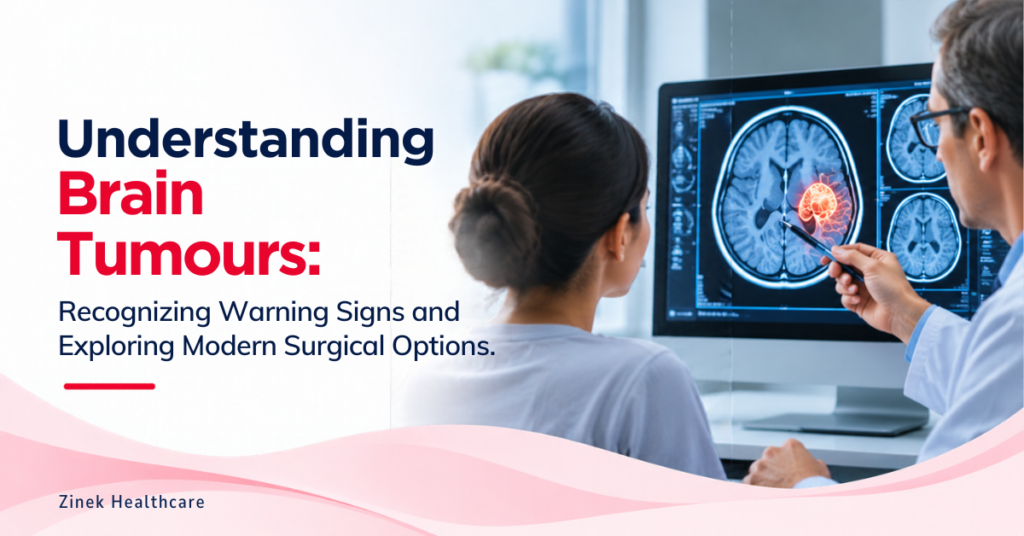
If a doctor suspects a brain tumour, an MRI is commonly used to examine the brain in detail. CT scans may also be useful, especially when urgent imaging is needed.
A neurological examination checks functions such as strength, balance, coordination and vision.
In some cases, doctors recommend a biopsy or surgery to collect tissue. Laboratory testing helps identify the tumour type and grade. Molecular testing may also guide treatment decisions.
PET scans have a role in selected cases, but they are not needed for every patient.
Modern Brain Tumour Surgery and Treatment Options
Treatment depends on the tumour’s type, size, location and behaviour, along with the patient’s overall health.
Image-guided brain surgery: Surgeons use detailed scans and navigation systems to plan the operation. The aim is to remove as much tumour as safely possible while protecting important brain functions. Some tumours cannot be fully removed because of their location.
CyberKnife and stereotactic radiosurgery: Despite the word surgery, these treatments do not involve an incision. They deliver focused radiation to a specific area. Doctors may recommend them for selected small tumours, brain metastases or situations where open surgery is unsuitable.
Radiation therapy and chemotherapy: Some patients need treatment after surgery, particularly when the tumour is malignant or cannot be completely removed.
Targeted therapy and immunotherapy: Molecular tests may identify patients who could benefit from specific medicines. Immunotherapy remains under study for many primary brain tumours and is not a standard option for everyone.
The best approach may involve several specialists, including a neurosurgeon, neurologist, radiation oncologist and medical oncologist.
How Zinek Healthcare Supports International Patients
A brain tumour diagnosis often leaves families with difficult questions. Should they seek another opinion? Which specialist should review the MRI? What treatment might be recommended, and how much could it cost?
Zinek Healthcare helps international patients connect with hospital and specialist teams in India.
Families can share MRI reports, biopsy findings and previous treatment records to begin the coordination process.
Zinek can assist with hospital options, specialist appointments, treatment estimates, medical visa guidance, airport pickup and accommodation planning.
The initial treatment estimate request is free. Any further medical opinion or treatment charges should be confirmed with the hospital.
Zinek coordinates the journey. Diagnosis and treatment decisions remain with qualified doctors.
Have a brain tumour diagnosis or need another medical opinion? Share your medical reports with Zinek Healthcare to discuss specialist review and treatment planning in India.
Frequently Asked Questions
What are the first signs of a brain tumour?
Possible signs include worsening headaches, seizures, vision problems, unexplained vomiting, weakness and changes in memory or behaviour. Symptoms vary, and medical tests are needed to find their cause.
Can a brain tumour be treated without surgery?
Sometimes. Radiation, medicines or regular monitoring may be recommended depending on the tumour’s type, size and location.
Is CyberKnife suitable for every brain tumour?
No. CyberKnife is used for selected cases. A specialist must review imaging and the diagnosis before recommending it.
Can international patients request a brain tumour treatment estimate before travelling?
Yes. Patients can share medical reports for an initial review and estimate request. The hospital may need further tests before confirming a treatment plan.